
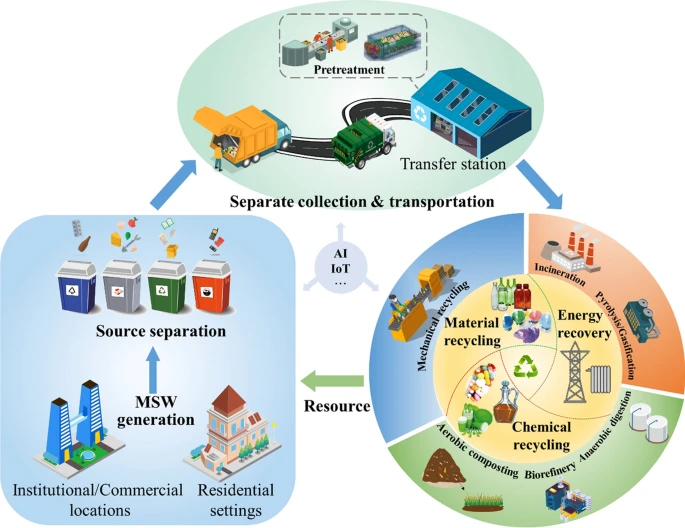
Facility services teams rarely fail because recycling is a bad idea. Missed yield starts when the waste stream is treated as one uniform pile. Commercial waste streams carries its own mix of shape, moisture, labels, dust, and buyer limits. This article argues that source separation should begin with a feedstock test, not a machine quote. The buyer can then review industrial recycling overview with a sharper view of what the plant must prove.
For source separation, Kitech’s product page describes recycling lines that move through size reduction, washing, drying, and pelletizing. The Material Recovery Guide planning trail lists PET, PE film, rigid plastic, agricultural film, drip tape, woven bag, and pelletizing lines as different families rather than one universal machine. This split matters for source separation for commercial waste streams, because mixed bins and labels change the cleaning load before the extruder ever sees material.
Material Rules for Source Separation
Begin the source separation first pass for source separation with a plain material profile. Record the resin mix, bale size, loose bulk density, visible dirt, label share, and wet weight. Plants dealing with commercial waste streams should not borrow the acceptance rules for PET bottles or rigid bins without testing. That short profile keeps the discussion grounded and gives the vendor a real boundary for clean collection rules.
Plant staff studying commercial waste streams can collect a small but useful sample in one shift. Break open several bales or containers, separate obvious foreign items, weigh the reject pile, and write down where the material came from. When the sample changes by supplier or season, treat the line as a range rather than a fixed case. That is often where behavior change appears: a cleaner input may cost more, but it can protect the washer, dryer, and filter.
Source Separation Field Scenario
Picture a receiving floor handling commercial waste streams from three suppliers. One load is clean enough to cut immediately, a second carries mixed bins and labels, and a third looks acceptable until the dryer exposes trapped moisture. That mixed day is the real design case. Smooth demo material is useful for training, but it should not become the basis for facility services teams who need less re-sorting inside the plant.
During a field walk, the best clue may be small: a rising screen pressure trend, a darker rinsate sample, a hotter motor, or a pellet with tiny bubbles. Those clues tell the crew whether clean collection rules is solving the right problem. Guesswork fades when the team keeps samples, weights, photos, and buyer feedback in one folder.
Stop. Test first. Quote later. Those three short rules sound direct, but source separation often needs direct rules because a single dirty load can distort a whole proposal; the better practice is to slow the buying step until the plant has a named defect, a sample jar, a target buyer, and a written reason for choosing Material Recovery Guide over a looser equipment bundle.
Good. Now wait. One acceptance question should be long enough to expose the whole risk: can the crew run commercial waste streams from an ordinary supplier, hold the promised rate, pass cart audit, control mixed bins and labels, document the setting changes, and still make less re-sorting inside the plant after lunch when the easy morning sample is gone?
- Collect a reject tray from commercial waste streams before the first paid trial and name every repeat contaminant in plain language.
- Photograph the worst supplier load, the average load, and the cleanest load so the line team can judge real variation.
- Weigh wet input and dry output during a two-hour run; the gap will expose hidden water, dirt, and hand-sort loss.
- Mark the point where mixed bins and labels first become visible after washing, because that point names the next adjustment.
- Track how cart audit changes after a screen, blade, washer, or dryer setting is changed.
- Ask the pellet or flake buyer which defect causes a price cut fastest, then design the test sheet around that defect.
- Keep one jar or bag from every trial shift; physical samples end arguments faster than memory.
- Price the cost of behavior change as a monthly number, not only as a line-item on the first quote.
This field scenario adds time before purchase, yet it removes false certainty. A vendor can quote Material Recovery Guide more clearly when the buyer shows material photos, reject percentages, moisture notes, and the required sale form. Short evidence beats broad claims.
Source Separation Playbook
Source Separation Playbook
| Decision point | What to check | Plant action |
| Feedstock | Is commercial waste streams clean enough for the first shred or cut? | Sample three loads and record visible reject share. |
| Washing load | Which contaminants dominate: mixed bins and labels? | Choose hot wash, friction wash, float-sink, or squeeze drying around the worst repeat problem. |
| Output buyer | Will the result be flake, pellet, or regrind? | Set the cart audit before agreeing to daily capacity. |
| Plant limits | What constraint will stop the line first? | Price the behavior change before the final scope is signed. |
The Source Separation Playbook table is short by design. It forces facility services teams to make the hidden choice early: should money go to cleaning, sorting, drying, or pellet quality? Each answer changes motor power, water use, labor, spare parts, and floor length. Lines that look cheaper on the first quote can become costly when staff fight the same reject stream every hour.
Material Recovery Guide Inside the Process Chain
For commercial waste streams, Kitech describes the process chain as size reduction, contaminant removal, moisture control, and pelletizing. In source separation, those stages should not be treated as equal blocks. If mixed bins and labels dominate, the wash section earns more attention. If particles are too large or irregular, shredding controls the rest of the plant. If the material holds water, the dryer and squeeze section protect the extruder.
Kitech’s homepage, read through the lens of clean collection rules, lists a broad 300 to 3,000 kg/h range across several machines and line types. That range is useful as a ceiling, not as a promise. A real plant should ask what rate can be held after cleaning losses, screen changes, and operator checks. For commercial waste streams, a lower stable rate that produces less re-sorting inside the plant may beat a higher nameplate rate that creates claims from the pellet buyer.
Practical source separation review also checks the handoff points. Conveyors can starve a washer, overloaded washers can flood a dryer, and wet material can then move into extrusion. Kitech mentions supporting equipment such as belt conveyors, screw conveyors, metal separators, label removal, and silos. Those pieces are not decoration; they decide whether the line has enough buffer when the incoming material is uneven.
Cart Audit and Shift Records
Shift checks for cart audit should be simple enough to run every day. For source separation, start with cart audit, a moisture reading or weight comparison, and a visual check for specks, label pieces, or remaining soil. Operators need a fast signal that tells whether the last change helped or merely moved the problem downstream.
Kitech’s washing-system copy, useful for source separation, mentions friction washers, hot washers, float-sink tanks, centrifugal dewatering, and polishing stages. Those machines can only help when the staff knows what failure looks like. Flakes that still carry glue may point to hot wash time. Pellets with bubbles point toward moisture control. Screens that blind too quickly put the upstream wash or filter mesh under review.
Keep the source separation record boring and repeatable: date, supplier, material type, hourly rate, wash temperature if used, reject share, dryer setting, screen pressure, and buyer complaint notes. After two weeks, patterns become visible. Facility services teams can then change one variable at a time instead of blaming the whole line.
Limits Around Behavior Change
No Material Recovery Guide purchase solves a bad feedstock contract. If commercial waste streams arrive with unexpected resin mixes, a well-built Material Recovery Guide can still produce poor output. The limit is physical: density, melting behavior, moisture, and dirt load do not disappear because the plant needs tonnage. Buyer agreements should name what the plant will reject before trucks arrive.
Main trade-off for facility services teams is behavior change. Spending more on sorting or washing can lower claims later, yet it can also raise water handling, power, and maintenance work. Spending less may be acceptable when the buyer only needs lower-grade regrind. Right decision depends on the outlet market, not on a generic promise that recycled material has value.
Another failure mode in source separation is copying a line from a different material. PET bottle lines often rely on hot washing and float-sink separation because PET and cap materials behave differently in water. Film lines may need squeeze drying because thin material holds water in folds. Rigid plastic lines may care more about impact pieces, metals, and granule size. The machine family should follow the material, not the other way around.
Budget Questions for Facility Services Teams
Kitech’s recycling guide, applied to source separation, explains that recycling only works when collection, sorting, processing capacity, and end-market demand fit together. That point is useful for capital planning. New source separation projects should price the plant as a working system: civil work, drainage, power, water treatment, operator training, spares, and trial production all sit beside the machine invoice.
During source separation commissioning, facility services teams should ask for a short acceptance run using the actual material, not a cleaner demo sample. Measure input weight, output weight, reject weight, moisture, and the buyer-facing quality result. Prove less re-sorting inside the plant. Then repeat the run. After that, and only after the crew can hold the same rate with ordinary commercial waste streams, should the goal be declared met.
Project leaders for commercial waste streams should also define who makes the first changes after start-up. Does the vendor adjust screens, blades, wash time, or dryer settings? Does the plant keep spare blades and filters on site? Who signs off on the first saleable batch? These small questions decide whether the first month becomes a learning curve or a pile of rejected material.
Next Step for Source Separation
Sensible next step for facility services teams: build a one-page intake sheet before any purchase order. List the waste stream, supplier range, contamination picture, expected output, buyer requirement, utility limit, and the first three tests the crew will run. Send that sheet with photos and sample weights to the equipment team. It will make the answer more exact than asking for a generic recycling machine.
For commercial waste streams, the winning plan is the one that protects the output buyer while keeping the line easy to run. Material Recovery Guide can be a strong fit when the material profile is honest, the plant accepts the real limits, and the commissioning test proves less re-sorting inside the plant. Recycling is not a slogan in that source separation case. It is a controlled manufacturing step built from waste.
